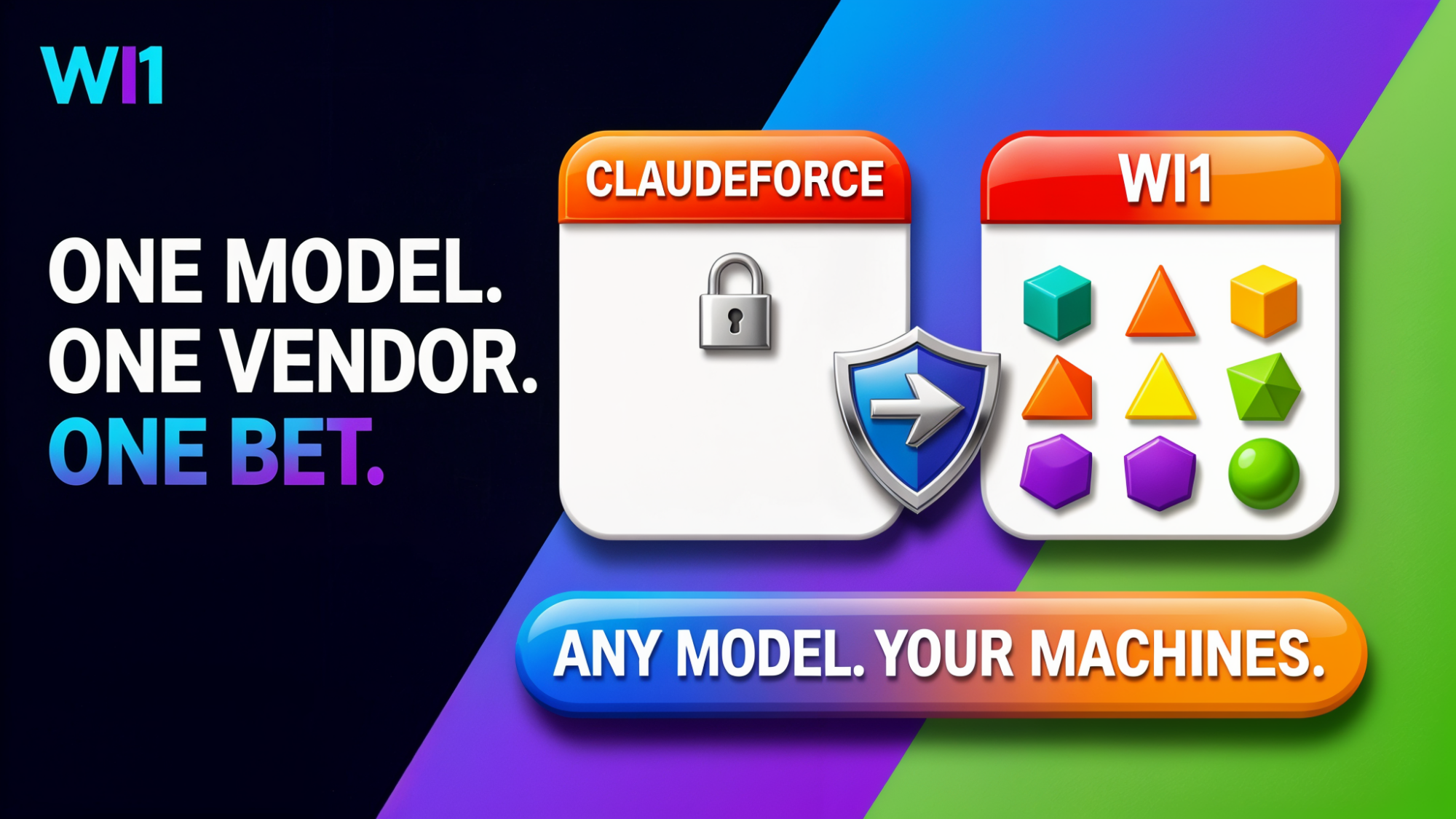
Salesforce and Anthropic have announced Claudeforce: Claude built directly into Salesforce’s CRM, pitched as “the #1 AI meets the #1 AI CRM.” It’s a big, confident partnership announcement, and it’s worth looking at closely, because it makes a bet that every business adopting it is forced to make alongside them: one AI company, wired permanently into one CRM.
That bet might work out fine for Anthropic and Salesforce. It’s a much riskier bet for the business that has to live with the result. Here’s what’s actually going on, and how WI1 was built to avoid making that bet at all.
What Claudeforce actually is
Strip away the branding, and Claudeforce is one AI model — Claude, from Anthropic — integrated into one CRM platform, Salesforce, as a deep, exclusive-feeling partnership. Every “AI meets CRM” claim in that announcement is scoped to a single vendor’s model sitting behind a single vendor’s software. If Anthropic changes its pricing, deprecates a model version, or shifts its usage terms, that decision lands directly on every business that built its Salesforce workflows around Claude. There’s no other model to switch to inside that product — the integration is the lock-in.
This isn’t a criticism of Claude as a model — it’s a genuinely capable one. The issue is architectural: welding one model permanently to one CRM removes the customer’s ability to ever change their mind.
How WI1 is built differently
WI1 runs its AI work through Hermes, an agent framework that treats the model underneath it as a swappable component rather than the foundation everything sits on. In practice, that means:
- Any provider, not one. WI1’s Hermes agents can run on Anthropic’s Claude, OpenAI’s GPT models, Google’s Gemini, xAI’s Grok, or open-weight models — whichever is genuinely the best fit for a given job, or the best value that week. Nothing about WI1’s CRM depends on any single AI company staying in business, staying priced the same, or staying willing to sell.
- Your own machines, not a shared vendor cloud. Hermes agents run on the business’s own PCs and on dedicated VPS instances WI1 helps set up — not exclusively inside a big tech company’s data centre. That means the work happens on hardware the business controls, and it means a business with spare capacity on an existing machine isn’t paying cloud-AI margins on top of compute it already owns.
- Local and cheap models where they’re good enough. Not every task needs the most expensive frontier model. Hermes lets routine work run on smaller, cheaper, or fully local models, reserving premium models for the tasks that actually need that level of reasoning. Claudeforce has no equivalent lever — it’s one model, all the time, at whatever Anthropic decides to charge for it.
- History and memory that outlive any model. In WI1, your leads, customers, documents, and the memory built up from working with your business live in the CRM itself, not inside a chat session tied to one provider’s product. Swap the model behind an agent and the CRM’s record of your business doesn’t move — it was never inside the model to begin with.
Why this matters more than the headline model comparison
The interesting comparison here isn’t “Claude vs whichever model WI1 happens to use today” — that comparison changes every few months as models leapfrog each other, and it will keep changing. The comparison that actually matters for a business choosing a CRM is: what happens to your workflows on the day your current model gets more expensive, gets deprecated, or a better one from a different company comes out?
With Claudeforce, that day means a hard decision about your CRM itself, because the model and the CRM were sold to you as one product. With WI1, that day means pointing your Hermes agents at a different model — on the same machines, with the same CRM, the same history, and no migration.
Unlimited AI usage is cheap right now because providers are still fighting for market share. That won’t last forever, and it hasn’t lasted anywhere else in the AI industry over the last two years — prices have moved, free tiers have vanished, and models have been retired with a few months’ notice. A CRM that only speaks one model’s language has no answer for that. One that runs its own agents, on its own machines, able to use any provider’s model, does.
That’s the difference between betting your CRM on one AI company’s roadmap, and building a CRM that doesn’t need to bet at all.