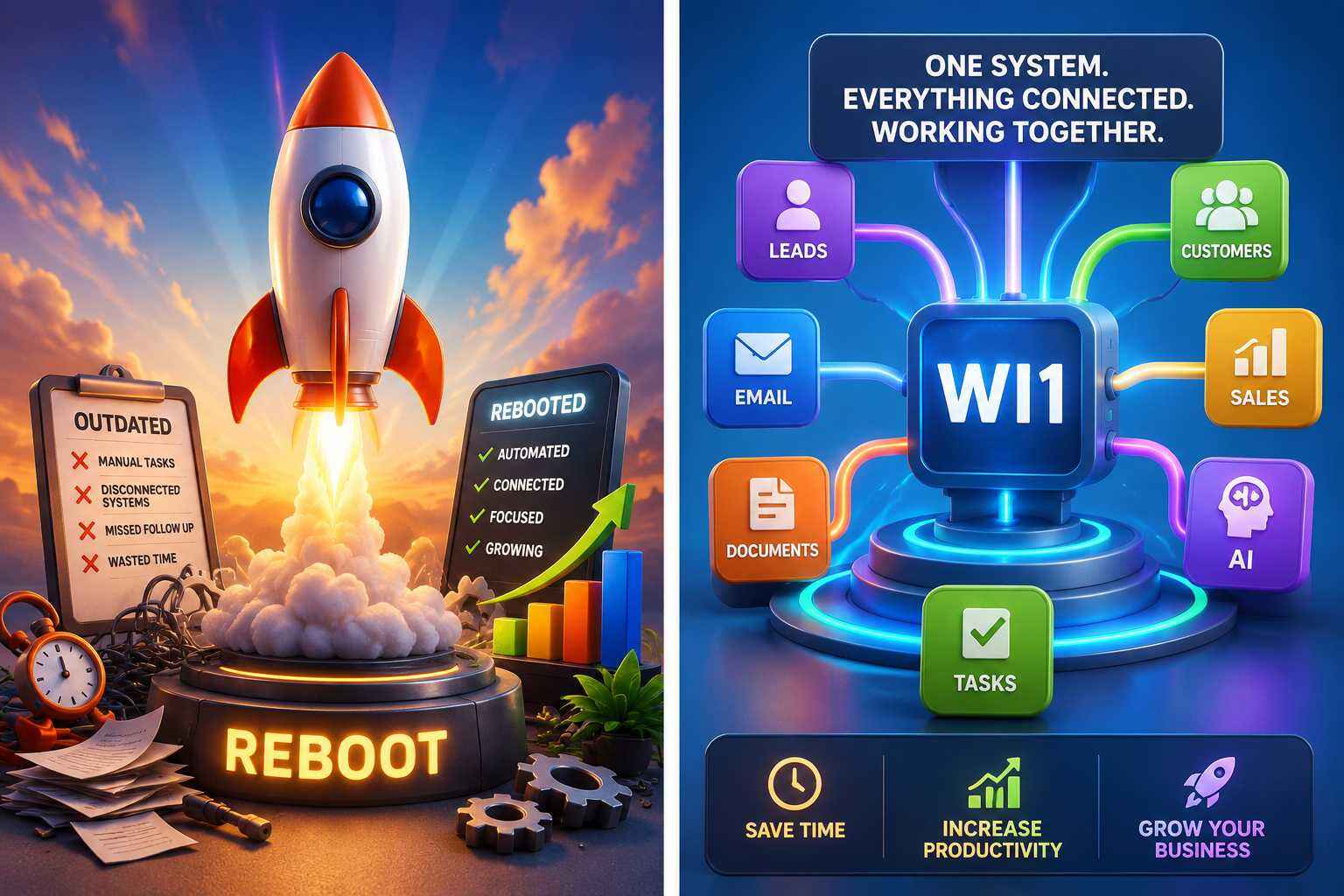
Small businesses rarely set out to create complicated systems. The complexity develops gradually. A spreadsheet is created to track enquiries. Another system is introduced for email marketing. Customer notes are stored in an inbox. Tasks are managed on a separate platform. Documents are saved in different folders. A CRM is purchased, but only part of the business uses it. An AI tool is added, but it cannot access the information it needs.
Each decision makes sense at the time.
Years later, the business is running through a collection of disconnected tools, manual processes and knowledge held in people’s heads. The business is still ticking over.
But it needs a reboot.
The problem is not always the software
Most small businesses already have enough software. The problem is that the software does not work together.
A new customer may complete a form, but someone still needs to copy the information into another system.
A sales enquiry may arrive by email, but there is no automatic follow up if nobody replies.
A member of staff may update a spreadsheet, but the rest of the team does not know anything has changed.
Customer documents may be stored in several places.
Tasks may be created manually after every phone call or meeting.
The business operates, but only because people constantly move information from one place to another. That is expensive, slow and prone to error.
What a business reboot should achieve
A reboot should make the business easier to run.
It should reduce repetitive work.
It should make customer information easier to find.
It should improve follow up.
It should give staff a clear view of what needs to happen next.
It should stop important tasks being forgotten.
It should reduce the number of systems people need to check.
It should also make AI genuinely useful by giving it access to the right information and clear instructions.
The objective is not technology for its own sake. The objective is a business that operates more consistently.
Bring customer information together
Customer information often exists across many locations.
The CRM contains contact details.
The inbox contains recent conversations.
A spreadsheet contains quotes.
A shared folder contains documents.
The calendar contains meetings.
A member of staff remembers the rest.
This makes it difficult to understand the complete customer relationship.
A reboot should bring the most important information into one usable view.
That does not necessarily mean copying every piece of data into one database.
It means connecting the right systems so that staff and approved AI agents can access the information needed to complete a task.
Automate the gaps between systems
Much of the administrative work inside a business happens between systems.
A form is submitted, then someone creates a task.
A customer replies, then someone updates a checklist.
A quote is accepted, then someone creates a project.
A meeting finishes, then someone writes a summary and emails the next steps.
An invoice becomes overdue, then someone remembers to chase it.
These gaps are where automation provides the greatest value.
The individual task may only take a few minutes.
Repeated across many customers and many working days, it becomes a significant cost.
Give AI a specific job
Adding a general AI chatbot does not reboot a business.
AI becomes valuable when it has a defined task, the right information and clear boundaries.
For example, AI could:
- Review incoming enquiries and prepare responses.
- Check which customer documents are still missing.
- Draft follow up emails.
- Summarise meetings and create tasks.
- Prepare a weekly management report.
- Identify customers who have not been contacted recently.
- Create content based on common customer questions.
- Research potential leads before a sales call.
- Find information across company documents.
Each action can include human approval where necessary.
The AI does the repetitive preparation.
A person remains responsible for important decisions.
Make the business less dependent on memory
Many small businesses rely on staff remembering what needs to happen.
Someone remembers to chase a quote.
Someone knows which customer needs a call.
Someone remembers how a particular process works.
Someone knows where the latest document is stored.
This may work while the team is small.
It becomes a problem when the business grows, a member of staff is absent, or the owner wants to step away from daily administration.
A reboot turns memory into process.
Tasks are created automatically.
Follow ups are scheduled.
Information is recorded.
Progress is visible.
Responsibility is clear.
Do not try to change everything at once
The best place to begin is usually the part of the business causing the most wasted time or lost opportunity.
That may be lead management.
It may be customer onboarding.
It may be chasing information.
It may be preparing quotes.
It may be email administration.
It may be internal reporting.
Start with one process.
Map what currently happens.
Remove unnecessary steps.
Connect the systems involved.
Add automation.
Use AI where it provides a clear benefit.
Measure the result.
Then move to the next process.
A better operating system for the business
A business reboot is not about installing more software. It is about creating a better way for the company to operate.
Customer information should be available when it is needed.
Tasks should not depend on someone remembering them.
Systems should share information.
AI should perform useful work rather than exist as a separate novelty.
Staff should know what needs to happen next.
Owners should have a clear view of the business without manually compiling reports.
The business does not need to be replaced.
The systems around it need to be improved.
It may not need another piece of software.
It may need a reboot.