xAI’s Grok Bot launched in beta on 11 August 2026 to a lot of noise — “always-on AI teammates with their own cloud computer” that can sign into your tools and run jobs unsupervised. A recent podcast interview with Billy Howell, who runs a local newsletter business almost entirely through Grok Bot agent teams, has pushed it further into the mainstream: the pitch is that anyone, technical or not, can spin up an agent team and run a real business end to end.
That’s an exciting idea, and some of what’s being built with it is genuinely impressive. But it’s worth looking past the excitement at what you’re actually signing up for — because the pricing and usage model underneath Grok Bot asks something of the person running it that a lot of non-technical business owners won’t be set up to give.
What Grok Bot actually costs
Grok Bot isn’t sold as its own standalone product. Access is gated through three existing subscription tiers:
- Cursor Ultra — $200 per month for an individual, confirmed on both xAI’s and Cursor’s own pricing pages.
- Cursor Premium Teams — $120 per seat per month, published by xAI (Cursor’s own pricing page doesn’t list a public seat price for this tier).
- SuperGrok Heavy — xAI’s top consumer tier, reported around $300/month, includes Grok Bot access.
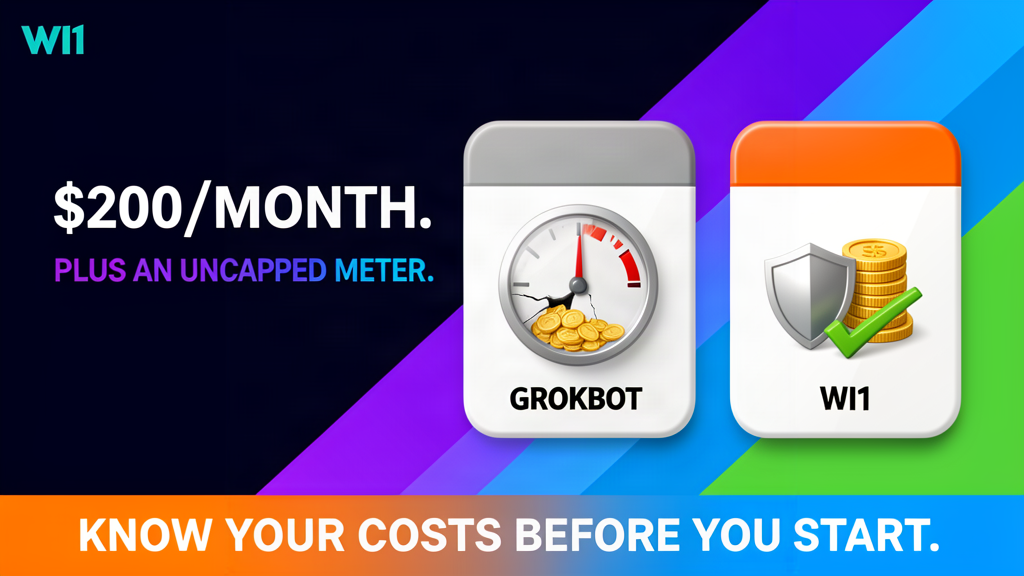
Each plan includes a weekly usage allowance of unpublished size. Go past it, and the pricing pages are explicit: extra usage is billed from model and token cost, with no spend cap yet. That’s the detail worth sitting with. $200 a month gets you in the door. It is not the bill. Independent coverage of the launch has already flagged this directly: budget for the seat, then budget again for the meter, and treat the first month as an experiment with an unknown ceiling rather than a fixed cost.
Fine for a power user. Awkward for everyone else.
If you’re comfortable watching a usage dashboard daily, understand roughly what a token is and what burns through them fastest, and can act quickly if an agent runs away with a job, an uncapped meter is a manageable risk. That’s the audience Grok Bot’s own docs are aimed at: agent power users, on Cursor’s highest individual tier.
But Grok Bot is increasingly being pitched — including in the podcast that prompted this piece — at exactly the opposite audience: non-technical people who want to run a whole small business through a team of agents, with no engineering background and no instinct for what “extended AI-token limits” actually means for their monthly bill. That’s a real mismatch. A product marketed as approachable for anyone shouldn’t require the person running it to become their own FinOps analyst just to avoid a surprise invoice. For a solo operator or a small team, the honest advice from the people testing it is to run everything on internal, reversible work first and set your own spending limit socially, because the product doesn’t set one for you yet.
Where WI1 takes a different approach
WI1 was built around the same basic idea Grok Bot is chasing — agents that don’t just answer questions but actually get on with tasks — but with control handled up front and cost made fully visible once the work is done, rather than left as a footnote for later:
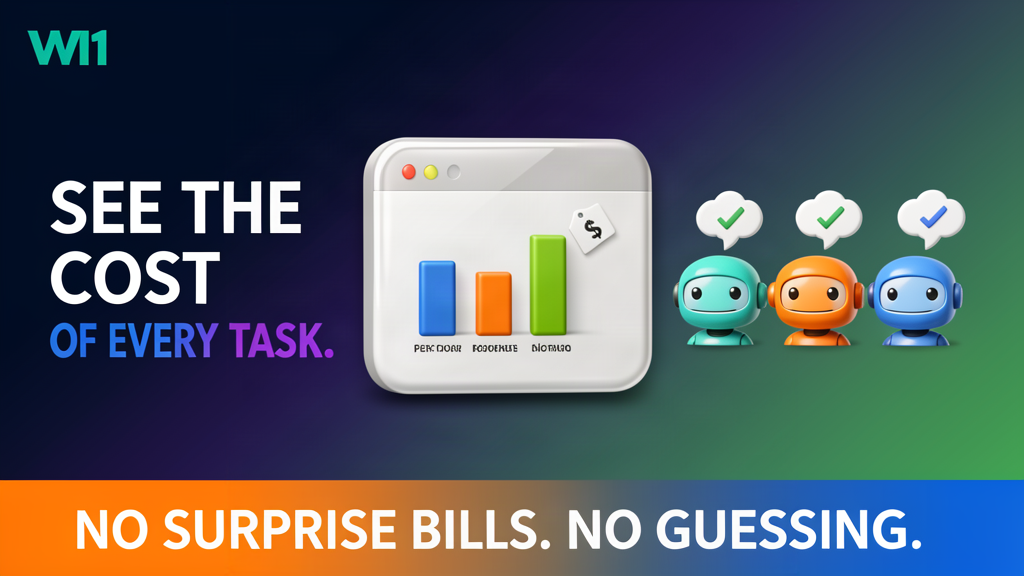
- You find out the cost once the work is done — never a price quoted upfront. Most real-world tasks can’t be priced in advance anyway (nobody knows exactly how much work a job will take until it’s done). WI1 doesn’t try — instead, once each task or project completes, it tells you exactly what that piece of work cost. That’s a real, itemised figure after the fact, not a monthly surprise buried in a bill, and it’s the number you’d pass on to a client if you’re billing for AI-assisted work.
- Every task is scoped and approved before an agent starts working — that’s about permission, not price. WI1’s agents look at a task, say what they can take on, and wait for a yes before touching it. There’s no equivalent of an agent quietly working through a weekly allowance and then billing you at raw token cost without warning.
- Any model, from any harness — including free ones. WI1’s agents run via Hermes, which can call models from any provider or agent harness, not just xAI’s own stack — Anthropic, OpenAI, Google, xAI, open-source and local models. That includes free models, which for most everyday tasks are now almost as good as the paid frontier ones. Routine work runs on something cheap or free; only the tasks that genuinely need it reach for an expensive frontier model. Grok Bot has no equivalent lever: it’s one product, one meter, at whatever rate applies that week.
- Built for people who aren’t watching a dashboard. Permissions are set once by a manager, per agent, and every agent asks before acting. The person running the business doesn’t need to understand tokens to stay in control of what an agent is allowed to do.
None of this is a knock on what Grok Bot can do — the always-on, sign-into-your-real-tools model is a genuine step forward, and the small businesses being built with it are real proof of that. The difference is who each product assumes is holding the reins. Grok Bot assumes someone comfortable with an uncapped meter. WI1 was built on the assumption that most people running a business shouldn’t have to be.
The bottom line
If you’re technical, watch spend daily, and want the newest agent product on the market regardless of the bill, Grok Bot is worth trying — with your eyes open about the meter. If you want agents doing real work in your business without needing to become the person who monitors token spend every morning, that’s the gap WI1 was built to close.